The Versatility of 10 Red and Green Gingham Patterns for Creative Projects
Pattern libraries are often underestimated in their ability to transform a project from ordinary to visually compelling. Among the vast array of textile-inspired designs, gingham holds a particular charm. It bridges the gap between rustic simplicity and structured elegance. When you encounter a curated set of 10 Red and Green Gingham Patterns, the immediate association might be holiday crafts. Yet, the utility of such a collection extends far beyond a single season. These patterns serve as foundational elements for designers, content creators, educators, and business owners who require reliable, high-resolution assets that do not compromise on aesthetic consistency.
Understanding the Core Characteristics of This Pattern Set
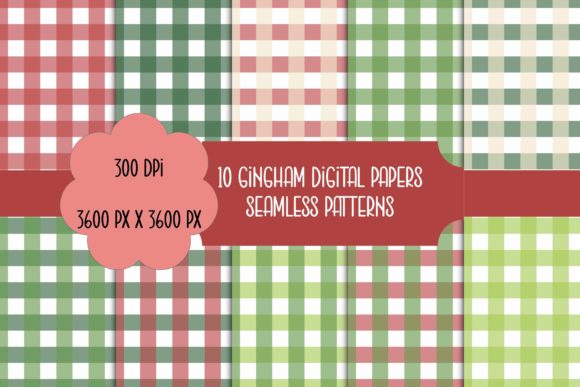
Gingham is defined by its distinct checkered layout, typically formed by two colors intersecting on a solid background. In this specific collection, the palette revolves around red and a spectrum of green shades. The greens range from deep forest tones to brighter, almost lime-infused hues, offering flexibility for different visual moods. Each pattern in the set is created as a seamless repeating tile, which means it can be tiled infinitely across a surface without visible seams or interruptions. This is a critical technical detail for anyone working on backgrounds for websites, printed materials, or textile mockups.
Every file in this package is delivered in JPEG format at 3600 pixels by 3600 pixels with a resolution of 300 dots per inch (DPI). At this dimension, the physical print size is exactly 12 inches by 12 inches. This resolution ensures that whether you are using the pattern on a digital screen or sending it to a commercial printer, the clarity remains sharp. The JPEG compression is balanced to preserve color depth while keeping file sizes manageable for quick downloads and efficient workflow integration.
Why Seamless Patterns Matter for Professional Work
When creating backgrounds for websites, social media graphics, or printed stationery, the last thing you want is a visible repeat line that distracts the viewer. Seamless patterns eliminate that concern. The 10 Red and Green Gingham Patterns have been engineered so that the edges match perfectly. This allows for unlimited scaling without breaking the visual flow. For a web designer building a landing page for a Christmas-themed product, a seamless gingham background can evoke nostalgia without appearing amateurish. For a scrapbooking enthusiast, it means being able to cover an entire page spread with a cohesive look, rather than piecing together mismatched sections.
Practical Applications Across Different User Groups
One of the strengths of a versatile pattern set is its ability to serve multiple industries and creative disciplines. Below are distinct user groups who benefit from having access to a collection like this.
Graphic Designers and Digital Artists
For professionals who work in branding, packaging, or digital illustration, texture is a key component of visual identity. Gingham offers a way to introduce a handcrafted feel into modern designs. You might use one of the lighter green variations as a subtle background for a minimalist holiday card, while a bold red-heavy pattern could anchor a poster or banner. The 3600px resolution gives enough real estate to extract smaller sections or crop specific areas without losing quality. Designers often layer these patterns with typography or vector illustrations, and the seamless repeat ensures that even when scaling the background up, no awkward interruptions occur.
Content Creators and Social Media Managers
In the world of content creation, seasonal aesthetics drive engagement. A pattern set like 10 Red and Green Gingham Patterns becomes an immediate resource for video backgrounds, Instagram story templates, or YouTube thumbnail elements. Instead of designing from scratch each holiday season, a creator can rotate between the ten variations, keeping the visual theme consistent but never repetitive. The JPEG format is universally compatible with video editing software, presentation tools, and photo editing apps. This saves hours of production time, especially when deadlines are tight.
Hobbyists and Scrapbooking Enthusiasts
Paper crafts remain a beloved medium for personal expression. With patterns that are print-ready at 12x12 inches, scrapbookers can print directly onto cardstock or adhesive paper. The physical size matches standard scrapbook page dimensions, making it effortless to create double-page layouts. The mix of red and green hues allows for matching different types of family photos, from candid holiday gatherings to posed portraits. Because the patterns are seamless, you can also print them at smaller scales for banners, tags, or envelope liners without worrying about awkward repeats.
Educators and Workshop Facilitators
Teachers in art, design, or even early childhood education can use pattern sets as teaching tools. Discussing color theory becomes more concrete when students can see how different greens interact with the same red base. Explaining textile patterns, repetition, and rhythm in visual design is easier with tangible examples. Educators can print these patterns for mood boards, collages, or classroom decorations. The variety within the set provides enough examples for group activities where each student works with a different variation before comparing results.
Beyond Christmas: Year-Round Creative Possibilities
While the red and green color combination immediately signals the holiday season, these patterns are not limited to December projects. Consider the following scenarios where this palette works outside of Christmas contexts.
- Spring and Summer themes: Lighter green shades paired with red evoke picnic blankets, garden parties, or outdoor markets. A red and light green gingham can feel fresh and cheerful rather than holiday-specific.
- Wedding stationery: Rustic or barn-style weddings often incorporate red and green elements, especially for autumn nuptials. Save-the-date cards, programs, or table numbers printed on these patterns add a personal, handmade touch.
- Branding for food and beverage businesses: Restaurants, cafes, or bakeries that emphasize homemade or farm-to-table values can use gingham in their visual identity. Think of a pie shop using a red and green check as a takeout box liner or a menu background.
- Textile and fashion mockups: Apparel designers often test fabric patterns digitally before producing physical samples. These files can be applied to dress silhouettes, scarves, or accessory mockups to visualize how the checkered design behaves on different forms.
- Educational posters and infographics: A subtle gingham background can make educational content feel approachable and visually organized without distracting from the core information.
Technical Considerations When Using JPEG Pattern Files
JPEG is one of the most widely supported image formats across platforms, but it does have specific characteristics users should understand. The compression algorithm introduces slight loss of detail, though at 300 DPI and 3600px dimensions, this is negligible for most applications. For users who require lossless editing, converting the JPEG to a TIFF or PNG within their workflow is straightforward. However, for the majority of uses—web backgrounds, printed scrapbook pages, or presentation slides—the JPEG format delivers an excellent balance of quality and file size.
The physical print size of 12 inches by 12 inches at 300 DPI is ideal for square formats. If your project requires a rectangular print, you can easily crop or stretch the pattern using software like Photoshop, Canva, or Affinity Designer. For digital applications, the high resolution means you can scale the pattern down significantly without degradation, but scaling up beyond 12x12 inches may require careful consideration of the viewing distance. For large-format prints like banners or backdrops, you might want to use the pattern as a repeating tile over a larger canvas rather than attempting to stretch a single tile beyond its intended dimensions.
Color Consistency Across Devices
Red and green are both relatively saturated colors. When working with 10 Red and Green Gingham Patterns, be aware that different screens display color differently. A monitor calibrated for photography will show the red as deep and rich, while a standard laptop screen might render it slightly orange. If you are printing these patterns, consider soft-proofing the file against your printer's color profile. Many commercial printers accept sRGB or Adobe RGB, and the JPEG files can be embedded with color profiles to maintain consistency. For digital-only projects, sRGB is generally the safest choice for web viewing.
Advantages of Having a Full Set of Ten Variations
Having ten distinct patterns within the same theme provides creative leverage that a single pattern cannot offer. Below are key advantages that come with a diverse yet cohesive set.
- Visual hierarchy within a single project: Use a bold, large-scale gingham for headers or focal points and a finer, subtler gingham for secondary spaces or backgrounds. The variety within the set allows you to build contrast without leaving the same color family.
- Testing and iteration: When designing a logo or a product package, you may want to test how different green tones work with your existing brand colors. Having ten options speeds up the iteration process significantly.
- Coordinated product lines: For small business owners who sell digital planners, printable invitations, or physical stationery, offering products in multiple coordinated patterns increases perceived value. Customers appreciate being able to choose their preferred shade or scale.
- Long-term usability: Trends change, but gingham remains a classic. Investing in a set of patterns means you have a resource that will stay relevant across seasons and design movements. The red and green variations can be mixed with neutrals, metallic accents, or modern typography to keep the look current.
Real-World Examples of Implementation
To illustrate the practical utility of these patterns, consider the following examples. A small business owner running an online store for handmade soaps might use a red-heavy gingham as the wrapping paper for holiday gift sets. The same business could use a green-dominant pattern on their website banner to create a cohesive brand experience. A teacher preparing a classroom bulletin board for a unit on pattern recognition in math can print several variations and have students identify the repeating unit, the color ratios, and the symmetry involved. A wedding planner designing a micro-wedding in a barn venue might use a light green gingham for the invitation suite and a deeper red version for table runners or signage.
In each case, the seamless repeat and the consistent resolution ensure that whether the pattern is printed on a home inkjet printer, a commercial offset press, or displayed on a high-resolution monitor, the result is predictable and professional. This reliability is what separates a casual pattern download from a genuinely useful design resource.
Considerations for Different Workflows
Users who work in vector-based software like Adobe Illustrator may want to import the JPEG as a reference or background layer. Because the pattern is raster-based, scaling it beyond 100% in a vector document may cause pixelation. For those who need an infinitely scalable version, tracing the pattern into a vector format is an option, but the original JPEG files are best used at or near their native resolution. For screen-based projects where the pattern will be viewed at 72 or 96 DPI, the 300 DPI source file provides more than enough detail, and you can safely reduce the resolution in your editing software to save file size.
Another consideration is file organization. The set arrives as a single ZIP archive containing ten JPEG files. Users handling large volumes of projects will benefit from renaming files descriptively, such as "red_green_gingham_01_dark.jpg" or "red_green_gingham_05_light.jpg." This practice saves time when searching for a specific tone or scale during a busy production day.
Why Gingham Endures as a Design Element
Gingham has roots in textile history dating back centuries, but its appeal in modern design is tied to its clarity and emotional resonance. The pattern is neither too busy nor too plain—it strikes a balance that feels both structured and approachable. In the context of the 10 Red and Green Gingham Patterns, this balance is amplified by the thoughtful color curation. Red brings warmth, energy, and focal attention. Green offers calm, nature, and balance. Together, they create a visual experience that can be festive, elegant, rustic, or playful depending on the shade combination and scale chosen.
For creators who value efficiency without sacrificing aesthetics, having a ready-to-use set eliminates the friction of designing a seamless pattern from scratch. It also removes the guesswork around color matching. When you have ten patterns that are designed to work together, you can mix and match with confidence, knowing that the technical parameters are consistent across the entire collection.
Final Observations on Practical Usage
The decision to use pattern sets like this one ultimately depends on the scope of your project and your audience's expectations. A hobbyist scrapbooker might print a single pattern for a holiday album page and feel completely satisfied. A professional designer working on a packaging line might cycle through all ten patterns before selecting the one that best complements the product photography. An educator might use the set across an entire semester, introducing different patterns as examples of color theory, repetition, and cultural associations with pattern design.
What makes the 10 Red and Green Gingham Patterns valuable is not just the aesthetic appeal but the technical readiness. The 3600px by 3600px canvas, the 300 DPI resolution, the seamless edge matching, and the JPEG format all converge to reduce friction in the creative process. Whether your work is entirely digital or primarily physical, this collection provides a dependable foundation that can be adapted, layered, and customized without demanding additional preparation. The patterns are ready to use the moment you unzip the archive, which is exactly what a busy creator needs.
In a media landscape where visual consistency and production speed are both in high demand, pattern sets that deliver on both fronts will always have a place in the creative toolkit. The red and green gingham combination, with its seasonal flexibility and timeless structure, is particularly well-suited for projects that aim to feel both personal and polished. By understanding the characteristics, advantages, and practical considerations of using these patterns, you position yourself to make informed creative decisions that align with your audience's expectations and your own artistic standards.