Cartoon Cat Seamless Vector Patterns SVG: What to Know Before You Buy or Use Them
If you have ever shopped for digital design assets, you have likely stumbled upon the phrase “Cartoon Cat Seamless Vector Patterns SVG.” At first glance, it sounds like a straightforward product: a collection of playful cat motifs arranged into a repeatable pattern, ready to drop into your project. And in many ways, that is exactly what it is. But there is more beneath the surface. Whether you are a small business owner printing custom fabric, a freelance designer building a textile collection, or a hobbyist creating one-of-a-kind gifts, the difference between a smooth workflow and a frustrating experience often comes down to a handful of details that are easy to overlook.
Let’s walk through what this type of pattern set actually offers, where people tend to stumble, and how you can avoid the common pitfalls that waste time, money, or creative energy.
What Is a Cartoon Cat Seamless Vector Pattern Set, Really?
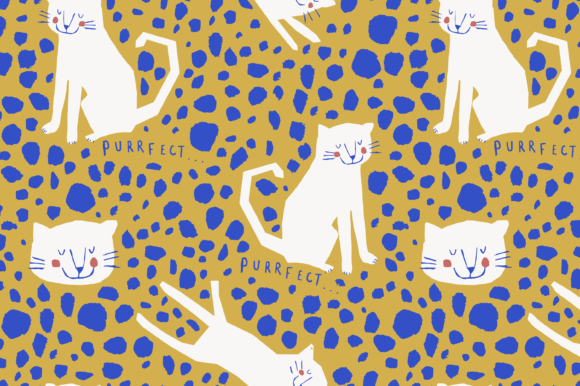
At its core, a Cartoon Cat Seamless Vector Patterns SVG is a digital file collection featuring cat-themed illustrations arranged so they repeat without visible seams. The design is typically placed on a solid background—often yellow in these sets—and includes abstract objects along with the cartoon cats. The result is a lively, cohesive pattern that works for everything from fabric printing to wallpaper, packaging, or digital backgrounds.
What makes it vector-based is key. Unlike a raster image (think JPEG or PNG), a vector file uses mathematical paths. That means you can scale it up to billboard size or shrink it down for a sticker without any loss of sharpness. The product description often mentions an EPS 10 version, SVG files, and compatibility with Adobe Illustrator, plus a range of output formats including AI, EPS, PDF, JPG, and transparent PNG. The promise of “easy color changing” and “editable and customizable” lines is a major draw for professionals and DIYers alike.
But here is where the practical reality sometimes diverges from the promise.
Mistake #1: Assuming All Vector Files Are Equally Editable
A common misunderstanding is that every file in the bundle is fully editable in the same way. Many people open the JPG preview and try to change colors, only to realize that a raster file does not allow for easy recoloring. Others open the EPS file in a program that does not fully support vector editing and conclude the product is broken.
When the description says “easy color changing” and “editable and customizable,” it specifically refers to the vector files—usually the AI and EPS formats. These contain the actual paths, fills, and strokes that you can modify in software like Adobe Illustrator, Affinity Designer, or CorelDRAW. The JPG and PNG files are meant for preview or immediate use, not for editing.
What to do instead: Before you buy, check which file format you will actually need for your workflow. If you plan to recolor or adjust elements, make sure you have access to a vector editing program that can open AI or EPS files. If you are only using the pattern as-is, the PNG with a transparent background might be all you need. Knowing the difference saves you the disappointment of expecting full editability from a raster file.
Mistake #2: Overlooking the “Expanded Outline Path” Detail
One phrase in the product description often gets glossed over: “All style line and stitching line are expanded outline path.” This is actually a crucial detail for anyone who works with fabric printing, cut-and-sew projects, or detailed illustrations.
When lines are expanded, they become solid shapes rather than strokes. This means the line thickness remains consistent regardless of scale. It also means that if you try to edit the line weight later, you cannot simply adjust the stroke width—you would need to manually modify the shape. For most print and textile applications, expanded outlines are a benefit. They prevent lines from disappearing or becoming too thick when scaled, and they ensure the design prints exactly as intended.
Where people get tripped up: A beginner might expect to be able to change line thickness with a slider. When they cannot, they assume the file is broken. In reality, the outlines have been expanded deliberately for print reliability.
Better approach: Read the description carefully for this term. If you need editable strokes for a specific project—say, a laser engraving that requires hairline lines—you may want to confirm with the seller whether a stroke-based version is available. For most fabric, textile, and all-over print uses, expanded outlines are actually your friend.
Mistake #3: Ignoring the Scale and Resolution Requirements for Print
Vectors can scale to any size without loss of resolution—that is one of their biggest advantages. However, the raster files included in the bundle (JPG and PNG) are fixed at a certain pixel dimension. If you try to blow up the JPG to cover a large fabric roll, you will end up with blurry, pixelated results.
The product description emphasizes scaling “without loss of resolution,” but that applies to the vector files (AI, EPS, SVG, PDF). The JPG and PNG are typically provided at a reasonable resolution for preview or small-scale use, but they are not meant for large format printing.
Realistic example: Imagine you are printing tote bags. You open the PNG, place it on your mockup, and it looks fine on screen. But when you send it to the printer at full size, the edges become jagged. The printer rejects the file or the final product looks unprofessional.
What to check before you buy: Look at the product details for the specific resolution of the JPG and PNG files. If you plan to print at a large scale, make sure you use the vector version. If your workflow relies on raster files, consider whether the provided resolution meets your needs. Many sellers list the pixel dimensions in the description—do not skip that line.
Mistake #4: Using the Wrong File Format for Your Software
A single bundle might contain AI, EPS, PDF, SVG, JPG, and transparent PNG. That is generous, but each format behaves differently depending on the software you use.
If you are working in Canva, for example, you can upload SVG files directly and they remain editable for color changes. But if you try to open an AI file in Canva, it will not work. Similarly, older versions of Illustrator may struggle with EPS files saved in a newer format. The product description notes that the AI file is compatible with Illustrator version 10 minimum, which is actually quite old—so compatibility is broad. But if you are using a non-Adobe program, you may need to rely on the SVG or PDF formats instead.
Common frustration: A user downloads the zipped folder, extracts all files, and drags the AI file into a program that does not support it. They assume the product is faulty, when in reality they simply used the wrong format for their software.
How to avoid this: Before purchasing, note which software you will be using. If you are unsure, the SVG format is widely supported across web and design applications. The PDF is also a safe bet for many programs. And if you are using Illustrator, the AI or EPS files will give you the most editing freedom. The product includes a “Main File Zipped folder with All File format added,” so you have options—use the one that matches your tool.
Mistake #5: Underestimating the Royalty-Free License Terms
The phrase “Royalty Free Vectors” is reassuring, but it does not mean the same thing everywhere. Generally, royalty-free means you can use the design in multiple projects without paying additional fees per use. However, there are usually limitations: you may not be allowed to resell the pattern as-is, claim it as your own, or use it in certain trademarked contexts.
Where this becomes a problem: A small business owner buys a pattern set, uses it on a line of phone cases, and later receives a takedown notice because the license did not cover commercial redistribution of the digital files themselves. Or they try to upload the pattern to a print-on-demand site that requires proof of a commercial license.
Practical advice: Always read the license terms included with the purchase. Reputable sellers specify what is and is not allowed. If you plan to use the pattern for commercial products—fabric, home decor, apparel—check whether the license covers that use. If it does not, reach out to the seller. Many are happy to offer an extended license for a small additional fee. A few minutes reading the terms can save you legal headaches later.
Mistake #6: Overlooking the “Abstract Objects” and Background Color
The description mentions “cartoon cat and others abstract object seamless vector pattern isolated on yellow backdrop.” That yellow background is part of the design. Some buyers assume they can easily remove the background because it is a vector file, and that is true—but it may take extra steps.
If you open the AI or EPS file, the yellow background is likely a separate shape that you can delete or recolor. But if you open the JPG or PNG, removing that yellow background will be difficult, especially if it is a complex pattern with many overlapping elements.
Better approach: If you need the pattern on a different background color, use the vector file and change the background shape’s fill color. If you need a transparent background, the transparent PNG file is provided for that purpose—use it directly. Do not try to remove the yellow from a JPG; that will compromise quality and take unnecessary time.
Mistake #7: Not Checking the Scale of the Seamless Repeat
Seamless patterns repeat, but the scale of that repeat varies from set to set. Some patterns have a small repeat, meaning the motif appears frequently. Others have a larger repeat, meaning you see fewer cats across the same area. The product description often does not specify the repeat size in inches or centimeters.
Why this matters: If you are printing fabric for a dress, a very large repeat might mean only one or two cats fit on the garment, which might look odd. A smaller repeat creates a denser, more textured look. Neither is wrong, but one may suit your project better.
What to check: Look at the preview images carefully. See how many cats appear across the width of the sample. If you are unsure, save the preview and open it at actual size to estimate the repeat. Some sellers include a scale reference. If they do not, you can ask before purchasing. It is a simple question that prevents a mismatch between your vision and the final product.
Mistake #8: Forgetting to Test the Pattern in Your Actual Workflow
Even with all the right formats and licenses, the real test is how the pattern behaves in your specific project. A seamless vector pattern that looks perfect on screen might behave unexpectedly when applied to a curved surface, a stretched fabric, or a repeated tile in a web background.
For instance, if you are using the pattern in a print-on-demand mockup, the colors might shift slightly depending on the printer’s profile. If you are using it in a web design, the SVG might render differently across browsers.
Practical habit: Once you download the files, do a small test. Print a sample swatch at actual size on your home printer or a local print shop. Apply the pattern to a single product mockup before committing to a full batch. Check the file in your intended software at the actual dimensions you plan to use. This small step catches issues before they become costly mistakes.
What to Look for in a Quality Cartoon Cat Seamless Vector Patterns SVG Set
You now know what can go wrong, so let’s flip that around. Here is what a well-designed set should offer, and what you should verify before clicking “buy.”
- Clear format listings: The product should specify which vector formats are included (AI, EPS, SVG, PDF) and which raster formats (JPG, PNG). Look for the file versions mentioned, like “EPS 10” and “AI version 10 minimum.”
- Editable elements: The description should state whether the lines and colors are easy to change. The phrase “all style line and stitching line are expanded outline path” tells you the paths are ready for reliable printing but may not be stroke-editable.
- Transparent background option: If you need the pattern without any background, the transparent PNG is essential. Verify it is included.
- Royalty-free clarity: The license terms should be stated in the product page or included in the folder. If they are vague, ask.
- Visual previews: The preview images should show the pattern repeating at a realistic scale, not just a single tile. Multiple angles or mockup examples help you see how the design behaves in context.
- Scalability assurance: The product should explicitly state that vector files scale without loss. This is standard, but it is worth confirming.
Making the Most of Your Pattern Set
Once you have a quality set and you have avoided the common missteps, the creative possibilities open up. Use the Cartoon Cat Seamless Vector Patterns SVG for fabric all-over prints, throw pillows, tote bags, desktop wallpapers, wrapping paper, scrapbooking, digital collages, or even as a playful background for a children’s e-book. The abstract objects mixed with cartoon cats give it a contemporary, whimsical feel that suits both modern and retro aesthetics.
If you are a textile designer, the seamless repeat saves you the tedious work of aligning motifs manually. If you are a small business owner, having multiple file formats means you can hand off the AI file to a professional printer or use the SVG directly on your website. If you are a hobbyist, the royalty-free license gives you the freedom to experiment across projects without worrying about per-use fees.
The key is to treat the pattern set as a flexible tool, not a fixed asset. Test it, edit it, and adapt it to your needs. The best results come from understanding exactly what you have in your hands—and that starts with reading the details, choosing the right file format, and checking the scale before you start printing.
A little upfront effort saves you from the frustration of a mismatched project. A little curiosity about how vectors work opens the door to endless customization. And a little caution around licensing ensures your creative work stays yours.